Showing posts with label Crunch. Show all posts

Friday, November 30, 2012

Do you remember the first time? / I don't remember the worst time

It was February 1996. I was in the rather awkward position of having been invited to my friend Lani's birthday night out, and meeting her at my good friend Eli's house, who was her very recent ex. By about a week.
Eli shared his house with a guy called Camo. Both were (are) colossal geeks. Oh, they tried to hide it - Camo was a professional dancer and Eli was a Jujitsu champ and anti-establishment punk - but more than a five minute conversation with them and you knew they were nerds.
At the time I was friends with Eli for the punk rock and camaraderie. I didn't really know about RPGs.

All that changed on that fateful night. A night that Eli's brother Angus describes as 'the birth of a monster'.

It was snowing when I arrived at Eli's house. A good deep thick settling of snow that wasn't going anywhere fast. It was pretty much a certainty that I wouldn't be catching the bus home to my village in the sticks that night. I was snowed in in Leeds.
Awesome! A night out and a solid gold reason not to go home. Something every teenager dreams of.

The snow kept falling though, and soon we got the call from Lani saying that everyone was staying in.
Ok. What to do?
Eli and Camo fellback to their default position.
"So, what are we playing?"
"I could run a Cyberpunk cops game..." Said Camo. "Nook, you playing?"
I said yes. I didn't really have a choice. Play, sit and watch or take my chances in the blizzard. I'm sure this is how the KGB converted Western spies into double agents.

As mentioned, the game was Cyberpunk - a dark high tech future game dominated by mega corporations and street gangs.
We started creating our characters. Somehow I generated skill and ability scores and worked out the basic numbers. I had, and still have, no idea what they meant or did. It was a strange and arcane experience, reminiscent of the time I bunked a whole term of maths GCSE lessons then had no idea what was going on for the rest of the year.
Once we'd statted up our characters it was time to start buying stuff. And, my god, was there stuff to buy. Camo and Eli started to eagerly devour three separate books of equipment, picking out guns, armour, sunglasses, cyber-appendages, portable computers, tattoos, gadgets... I floundered and was given the advice "it's not so much about utility, it's about cool shit."
I bought my cop some portable electronic bongos, to positive head nods "I think he's getting it"
I most definitely was not.

Play started. We patrolled the mean streets of Night City. No crime was apparent, so I started playing my bongos. Turns out I was shit at it. I felt cheated.
Next I decided that my cop needed to drain his lizard. I hadn't grasped the agency I had to affect the story, so fell back on the mundane.
The Camo responded by making the bar I chose to take a leak a mob run speakeasy. Some stuff happened. My cop was ejected from the establishment.
I still didn't really know what I should be doing. I kind of stood there.
Camo took another tack, and radioed in a mission for us - protect a corporate limo as it traveled through the city.
Less sandbox, more mission based. Ok, I can get behind that.
We followed the limo on our cool cop bikes, keeping our eyes on the road ahead for any danger or ambush.
We didn't look up, though, which I now understand to be a cardinal error.
A rain of explosive fire fell on the street ahead and behind us, penning the limo into a tight spot.
From the rooftop above the world's least subtle sniper loaded a bullet in his chamber and took aim.
Another thing I now understand is that in a ranged fight, tactics, cover and concealment are key elements that help ensure success or, at the very least survival.
Eli's cop took cover behind the armoured limo and opened fire. The sniper was unfairly hidden, with a 12" concrete parapet as cover. Eli missed.
So I climbed on top of the limo, to get a better shot, and started aiming with my standard police issue pistol.
The good news is that I hit. My shot went through the concrete, through the snipers armour, and did him 1 point of damage. I was elated. A few more shots like that, and he'd be down.
Then he blew my arm off.
What The Fuck?! My character's actual arm! I was assured that he'd survive, and could get a cyborg replacement that would be better than the original and would only erode my sanity and morality slightly.

I remember my mind racing afterwards as I thought about everything you could do with this Roleplay thing. I thought about superheroes, gods, knights, sci-fi, everything I'd been interested in so far in my life could be filtered through this new medium.

Throwing away all pretense, here's some dice packaged up like the drug they are...

Monday, April 2, 2012

Cheating for fun and profit / Not everyone is created equal

I just remembered something important - NPCs, especially important ones, do not need to be legal starting characters.

They just need to make sense, be memorable and serve a function (other than "wank all over the players").


Saturday, January 14, 2012

Transformers Tech Specs / Half an RPG already

I may be behind the times, but I've only just seen Transformers Prime. Did you know it was developed by two of the writers behind Lost? Ok, also the two guys behind the Hawaii 5-0 reboot, but you can't have everything..

Anyways, my sudden resurging interest in 'classic' Transformers (as opposed to the Michael Bay travesty) reminded me of a thought I had a couple of years ago.

The classic Transformers toys came with a picture, brief character description and a rating of their various abilities: Strength, Speed, Endurance, Intelligence, Firepower, Skill, Rank and Courage - all rated between 1 and 10.

So, already we have a range of meaningful stats with assigned ranges.

To my mind, we just need to determine what system these stats support.

My original thought was a d10 'roll below your value' mechanic. This works for average stats, but means that characters with a score of 10 would automatically succeed, which is dull.

The other option is a target number mechanic - roll a d10 and add your score to it. Set 10 as a standard difficulty, and increase or decrease as the situation merits. Make 1's an automatic fail, and 10's an exceptional success, and you're away.

Hit points / health and damage

I guess you could either say that Strength and Firepower provide set values for damage inflicted, but again, that's pretty dull. A random element that allows for a range of results is far more interesting.

So, I guess I'd use Strength and Firepower as values to add to a d10 roll, which would give a min/max damage range between 2 and 20.
This would mean that hit points/health would need to accommodate this range, whilst still allowing Megatron to kill an Autobot with one shot from his fusion cannon, and giving said Autobot a chance of surviving said blast.
This would suggest to me a hit point range between 10 and 20, or a soak / damage reduction mechanic.

How's about hit points = Endurance + Rank, with Endurance also providing a set damage reduction value as well.
This would mean an attacker rolls Strength/Firepower +1d10 to determine potential damage, whilst the defender reduces the incoming damage by their Endurance score, and deducts any remaining damage from their hit points.
This makes it possible, but unlikely, for a Strength 1 Autobot to damage Megatron by punching him.

I'm sort of tempted to forego any 'to hit' mechanics, and speed up combat by having attacks hit automatically...
But, that removes a lot of the drama, and turns combat into a straight punching contest...

Speed should also play a part in combat. Definitely in determining Initiative, and also in determining the number of actions per round a character can take (observe Blurr in the original Transformers the Movie).
Speed could also be used to avoid incoming attacks as well. All of this does turn it into a combat super stat, though.

So. Revised system:
Attacker rolls Strength or Firepower + Rank +1d10
Defender rolls Speed +1d10 and deducts the result + their Endurance from the Attackers result.
This equals the amount of damage the Defender takes.

Or:
Each combatant has a number of actions each turn equal to their Speed.
They can split these actions between Attack and Defence. For example, a character with Speed 5 could fire two shots at an enemy and dodge three incoming attacks, or throw four punches and dodge one, or make no aggressive moves and dodge five incoming attacks.
To attack, roll 1d10 + Strength/Firepower.
To dodge, roll 1d10 + Speed. Subtract the result from the attackers successes.
Finally, subtract the defenders Endurance from the damage, and apply.

Or:
Difficulty to hit = 2x defenders speed. Endurance subtracts from the damage total as before, and any remaining damage is subtracted from hit points.


Tuesday, January 11, 2011

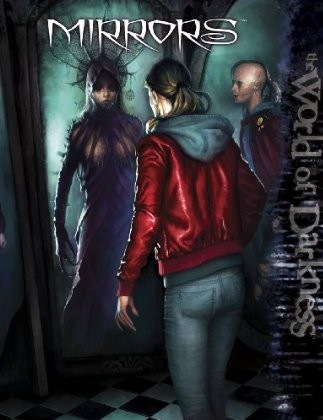
World of Darkness: Mirrors / Time of Judgement 2?

It has taken me ages to get my hands on this book. I missed the original release (which was around my birthday, which is doubly annoying) and it pretty much sold out world wide instantly. Now, some six months later, I have a musty smelling copy and am flicking through it.

The first page I read was the last page, which has coloured my understanding and appreciation of this book.
I'd not seen it explicitly stated anywhere else, which is surprising, but according to the afterword written by Rich Thomas, the World of Darkness RPG line is effectively discontinued, with 'Mirrors' being the last actual physical book that White Wolf, or more correctly CCP, intend on publishing.
In fact, I believe they have ceased the production of all gaming books. Looks like they're in the MMO business now.

Which made me look at the book differently.
World of Darkness: Mirrors is an 'option' book, focussing on alternative systems, settings and play options so gaming groups can 'open up' their enjoyment of the game and try different things. It presents alternative character creation, experience, character and general play options (or 'Hacks', as they are now commonly known), a whole chapter on different combat options - from diceless to miniatures, second by second expanded combat to streamlined fudging - a chapter on alternative settings and several essays on ways to alter your playing experience with house rules and different modes of play.
It's a legacy book. The line is ending, so let's produce a document that may empower the fan base to keep trying new things and keep the game fresh, so hopefully the system and setting will remain in use and in play despite the lack of new material.

It's a good book. It has real merit and should provide inspiration and/or depth to any World of Darkness game. It just makes me sad. I would class White Wolf and the World of Darkness as fairly high profile casualties of the recession and implosion of the RPG publishing market (for which I am currently blaming D&D, because i'm bitter).

I'm mostly enjoying the Setting Hacks chapter, which has three distinct parts:

  1. The World of Darkness Revealed - discussions on how the supernatural might go public, and how the world would react
  2. The World of Darkness Destroyed - ways to blow up the world
  3. The World of Darkness Dark Fantasy - ways to adapt the setting to different fantasy genres - high fantasy, sword & sorcery, modern fantasy, weird fantasy etc, and also includes three playable 'races' (sub races inspired by the 3 core game lines, so Dhampires, Wargaz [beast men] and Atlanteans), a new supernatural template - Heroic Mortals (for those Conan moments) and a named setting that can be used in a modern game: Woundgate.
The first two parts are, to me, very reminiscent of the game end options presented as part of the 'old' World of Darkness Time of Judgement. Again I am reminded that this is the last book they're putting out - it makes sense. It's just not a mandated end to the campaign.

The third part, Fantasy and Woundgate, could make a whole new game in itself. I think it needs a fair amount of further polishing, but there's definitely something there. It's very Gaiman - Neverwhere, Stardust, Mirrormask etc. The Woundgate setting introduces the idea of pocket realms of fantasy weirdness into the game. Lost worlds and secret parallels. 
I'm in two minds about it. Whilst I can definitely see how these remnants of the shattered Pangea could be used in the World of Darkness, it feels very 'old' WoD to me. Back when Mages could travel between alternate universes, pocket realms, spirit plains and alien worlds in a lunch time, when any mad idea could be shoe-horned into the setting because reality is malleable and multi-faceted.
I'd wanted a 'New' WoD Dark Ages game for some time, so I had high hopes for this setting. What they've given us is World of Darkness D&D, which is very different.

Included in the first chapter is the option to play 'Extraordinary Mortals', your Holmes', Bond's and House's. Otherwise normal people who possess a rare and exceptional skill focus. The system presents a selection of enhancements that can be taken to augment and support each skill, which allow a near superhuman level of achievement when certain criteria apply.
Extraordinary Mortals get to select three enhancements, and that's it. They do not develop any more unless through extreme and life changing challenges.

All in all, I can see World of Darkness: Mirrors adding depth and fresh twists to games that have gone on for awhile, or for groups that have played their normal game to death. At the moment I would say that I don't have an amazing amount of use for it. Yes, I'd happily use the Fantasy Shard occasionally, and may use some ideas from the character creation section the next time I run a WoD game. No, I wouldn't draw heavily on this  book for a new campaign or group. I see it as a tool box for seasoned players and storytellers.

The developer, Chuck Wendig, posted a long dissection of the book on his blog, which I feel is well worth the read. Several of the contributing writers have commented and added to the discussion, and Chuck has taken the time to answer various questions from readers and writers alike. Check it out...                                                                                              

Tuesday, December 7, 2010

Fighting Talk

I was reading Gameplaywright on my mobile phone on the way home from work, and they, in turn, pointed me to this blog entry by Ryan Macklin, which talks about how games that focus on story rarely focus and skills tests and vis versa.
Macklin's comments about 'beats' within combat got me thinking about RPG combat resolution mechanics. 
As you do.

His point was, kind of, that RPG combat often loses that cinematic flow and excitement due to the artificial interruptions of dice rolling and rule deliberation. Yes. I see that. 

Then I thought of something. 
Wouldn't it be great to have a combat that's narrated between players without the interruptions of dice rolls, but still took the abstract concept of skill points etc in account?

Here's my idea. 

Characters have a 'Combat' score. This score equals the number of 'Combat Moves' the character can perform in a round of combat.
A round of combat lasts an indeterminate length of time, and is best described as a flurry of activity within the combat - the participants circle each other, enter into a short burst of activity in which they attack and evade, then fall back to safer distance to plan their next move.
The character with the highest Combat Score goes first. If the scores are tied, then the GM arbitrates using such criteria as they find appropriate.
The players take it in turns to describe the combat, and are able to describe one Combat Move per point they have invested in their Combat Score. In an ideal combat, the players will react to and build upon the Combat Moves described by each other.
Once all Combat Moves have been described, the players roll their Combat Score + 1 Die. 
They then split their total between Damage and Defence - e.g. One player may roll a total of 9, and opt to allocate 5 points to Damage, and 4 points to Defence. This would allow them to apply 5 Damage to their opponent, and evade 4 points of Damage in return. Their opponent also splits their total in this way. Probably best to write the split down before declaring it. 
Anyways. 

It could play out like this:

Classic Fantasy example
GM: Your characters are gambling in a tavern when you have a disagreement about the legality of concealed cards. Words are exchanged and it becomes clear you must fight. 
You leap up from your seats at the table and quickly take in your surroundings. The tavern is dark and smoke filled, with tightly packed tables and chairs and is currently incredibly busy. A set of aged wooden stairs against the far wall lead to a narrow balcony. There are chandeliers about ten feet above your heads. The bar is a plank of wood laid across a collection of barrels, and is next to the doors.

[Player A has a Combat Score of 4. Player B has a Combat Score of 3. Player A goes first. Player A can describe 4 Combat Moves, whilst Player B can only describe 3]

Player A: I kick the table towards the cheating bastard, hoping to knock him off balance, and draw my sword!

Player B: I still have my flagon of ale in my hands, so I throw that in his face and reach for my daggers.

Player A: I swing my sword wildly at him, laughing and wiping the cheap ale from my face.

Player 2: I try to fall back into the crowd. Hopefully he'll hit an innocent bystander instead of me.

GM: Player A, you connect with somebody. You don't think it's the right person. Chaos erupts around you both.

Player A: Charge towards him, sword raised high, and land blows all around. One or more will hit him.

Player B: Dive forward, tackle him at waist level and sink my dagger into his side.

Player 1: Bring the pommel of my sword down on his head again and again and again.

[Both players have now described the combat using their assigned Combat Moves. Now they must determine their Combat Totals and decide how many points to assign to Damage and Defence.  
Player A rolls a 3, which he adds to his Combat Score of 4, giving him a Combat Total of 7.
Player B rolls a 5, which he adds to his Combat Score of 3, giving him a Combat Total of 8.
Player A decides he was more concerned with attacking than evading, so assigns 5 points to Damage and 2 points to Defence. 
Player B decides he gave as good as he got, so splits his total in half, with 4 points assigned to Damage and and 4 points assigned to Defence. 
Player A's 5 points of Damage are partially countered by Player B's 4 points of Defence, meaning he only delivers 1 point of Damage to Player B. 
Player B's even spread means that Player A suffers 2 points of Damage, and blocks 2 points.

After the first Round of combat, Player A has taken 2 Damage, and Player B has taken 1 Damage.]

All the numbers used are off the top of my head, and don't reflect what a balanced and well designed system would require. Probably. With these Damage totals, a characters hit points would either have to be very low, or we'd have to beef up the damage a bit.

Anyways - This post has been a bit of a tangent. I just had this idea, and really wanted to put it down before I slept. Any comments or improvements are more then welcome.

Sunday, December 5, 2010

Game design by Idiots - Fighting people

I think where a great many RPG games fall down is in the combat rules. However we try to dress up roleplay as a socially interactive hobby that's about character development and playing a part, we love to kill things. This is why most rulebooks dedicate an entire chapter to combat, and generally wave their hands when describing how you should play your character or interact with NPCs or other PCs.

I find the balance of combat rules hard. I have stated previously that I am turned off by complex or heavy combat rules - Exalted being the case in point, but any system that requires multiple rolls to resolve 'I hit him with my sword'.
I am also concerned with the disconnect between real time and combat time.
An example - I took part in a Rifts campaign about 11 or 12 years ago (god, that long?) and at one point we spent over 4 hours playing out a combat that took 17 seconds in game time.
WTF?! That's over 14 minutes of play per second of game time!
I think the culprit was the fact that we all could take extra actions (and had powergamed our characters with this end in mind) and we were fighting some 30+ opponents, however, no combat should run that long unless you're playing a strategy game.

Turn duration
So, how should combat time work? D&D uses a base of 6 seconds per combat turn, with actions broken up into attack, movement and minor actions, as well as a presumption that your character is actively avoiding being hit (hustling, they call it). Broken up like that, 6 seconds seems fair.
The World of Darkness rules use 3 second intervals, with characters being able to perform one directed action, move a bit and avoid being hit, as well as occasionally perform a reflexive action. That's a lot for 3 seconds.
Ars Magica 5th Edition also uses 6 seconds as its turn length, which includes movement, one attack and defence, as well as spellcasting.

Ah, now, that could be the differentiator. Fantasy spellcasting, as used in ArM and D&D, requires a good amount of time to wave your hands about, shout in an arcane and no doubt dead language and possibly burn some incense or sacrifice a goat, whereas WoD magic is usually an innate ability that just requires an effort of will. OK, Mage may require hand waving, shouting and the trappings of ritual, but that's the exception.

So, when asking how long a turn should last, I need to determine what actions the could characters conceivably want to perform in that time. Simple actions = short turns. Complex or esoteric actions = longer turns.

Initiative
Next question - Initiative, how should it work?
Most games use a stat + die roll, with the highest roller going first. Gumshoe uses a different method - whomever decides to act first, goes first, with the subsequent order of action going in the order in which the players arrived at the session. I kind of like this. Yes, it has no baring on the characters you're playing, and the  hyper aware ninja may end up going last because the player missed their bus, but we're dealing with an abstract system, not real life.
I've read of house rules where the players sit in order of their initiative modifiers, and just take all combat in that predetermined order. It's simple, and clearly works for some people.

So, do we need that extra step of rolling a dice at the beginning of each combat? What value does it add? Does the system reward you for going first, or does it treat all actions as occurring at the same time?
Is it better to be potentially able to kill each other simultaneously, or better to be able to gank the other guy before her gets to pull his gun and gank you?
Is it better that Greedo shot first, or Han, or both at the same time?
God knows.

But I need to decide on one for my system.
I could introduce a new stat - Speed - which could also be used to determine running speed and crap like that, but i'm loathe to do so. More stats equal more complexity.
That would leave me with using the Gumshoe idea, which is that the aggressor goes first, and then decide on some other method to determine order.

How's about: Aggressor goes first. The order of combat turns are then determined by the participants current Luck score, with the highest going first and the lowest going last. Participants with the same Luck score are deemed to be acting at the same time.
It is possible to disable or kill an opponent before they can act.

Actually hitting somebody
How do you fairly determine whether or not you've hit somebody, or been hit?
There's usually an attack roll, but what is that roll made against? A generic difficulty modifier - score 1 success/roll 10 or above and you've hit? Roll against a defence score?
The former can be seen as slightly unfair - players like having the chance to avoid being hit - whilst the latter requires another stat.
Another thing I like about combat in Gumshoe is that your character is not only presumed to be trying to avoid getting hit (like hustling in D&D), they are presumed to be diving for cover as well.
Which translates as -1 defence if you state you're stood upright in the middle of a room, not ducking, bobbing or weaving; normal defence if you don't state anything, and +1 defence if you state that you're cowering behind a 6" thick lead wall (and limiting your attack options in the process).

Ideally i'd like a combat resolution system that just works with the minimal number of die rolls. I've already decided to have flat damage, for simplicities sake, and I am now looking for a 'to hit' mechanic that allows for flexibility and simplicity.
I.E. I'd like it to make a difference if players duck behind walls and over turned tables or use enemy minions as human shields, yet intuitive and easy to resolve.

Any ideas?

Saturday, November 27, 2010

Game design by idiots, part II

Oh, how I love the way that Google Buzz doesn't link into Google Blogger...

Sam H - System wise, I like the idea.
In terms of implementation, perhaps have x number of skill slots, and the player can fill them as they first come across the need. This allows relevent skills to be useful early on (and thus preventing early death). For character advancement, new blank skill slots?

Stats - I'd let Strength apply both physically and mentally. How do you envisage the bad things for running out of a stat?

I like all the settings apart from 01A, because like you I don't see how it works


Good feedback, Sam. The idea of having instantly assignable skills is interesting, and i've seen something similar used for languages in Gumshoe games (in which you just state that you know X number of languages, and assign them as and when the need arises). 


My thinking behind the free form skill system, which I didn't articulate in the last post, is that there exists a contract between player and GM. As a player, if I buy a skill, I want, no, expect, the opportunity to use it, otherwise I expect the GM to have a quiet word and tell me to spend my XP on something else, and possibly suggest an alternative that the group may require in the next couple of sessions.
I also expect GMs to tailor challenges within a game so that they are challenging to a party, and don't require specific skills the party do not possess to overcome.
Let me rephrase that - that don't require specific skills the party do not possess to survive. There's nothing wrong with non-essential encounters that require a specific skill set to beat, as long as the main plot or the characters survival do not depend on success.
Failure builds character.

I digress.
A contract between player and GM. 
I have started writing up my system, and in it I explicitly state that a player and GM must agree on a skill as it is chosen - what it is, how it works, what it covers and most importantly that the player character is allowed to take it. 
By buying the skill, the player agrees not to take the piss, and by allowing it, the GM agrees to give the player opportunity to use it. 
This is a bit deus ex machina, but plays out like a TV serial in which a new mcguffin, fact or ability is introduced at the beginning of the episode, and oddly becomes crucial to the resolution of the plot about ten minutes from the end.


So, at character creation, I have specified that players should initially choose two skills, one which they think would be useful to the group, and one which they think is cool.
The GM then designs the game sessions to call upon these skills. All other actions should then be achievable through a basic die roll or through the expenditure of Strength, Sanity or Luck.


Also, failure on a dice roll does not have to mean that a character does not perform the action - they could still scale the wall, but twist their ankle as they climb down the other side, or hack into the bad guys computer and access his files, but download a virus at the same time.


The uses of Strength and Sanity are pretty interchangeable, you just have to come up with a reason why Sanity is applicable to the physical action you are attempting, instead of the default Strength. 


Strength also acts as a characters hit points / health levels, so it's best not to burn the one stat at the expense of the other. 


What happens if you run out of either stat?
Here's an extract from my notes:


Running on Empty
What happens when a character exhausts their reserves of StrengthSanity or Luck?
A character can lose Strength due to two reasons - they can burn it, or they can sustain damage. If a characters last point of Strength is lost due to damage, the character falls unconscious for 1d6 minutes. After this time they regain consciousness, but are weak and in great pain. They can only walk slowly, or crawl, and any sudden or vigorous exertion will cause them to pass out again for another 1d6 minutes. Any further damage sustained whilst on zero Strength permanently reduces the characters maximum Strength score. Once a characters maximum Strength score is reduced to zero, they die. Trying to burn Strength whilst in this state counts as physical exertion. If this is attempted, the character does not gain an additional d6 for their roll, and passes out upon completion.
If the final point of Strength is burnt, the character does not immediately lose consciousness, but is totally exhausted, and does not have the energy to run or exert themselves. If they sustain any damage whilst exhausted, then the character will pass out for 1d6 minutes and lose a point of their maximum Strength  score and all affects described above will take affect.
When a character loses their last point of Sanity, they become emotionally exhausted, tired and unfocussed. They are quick to tears and quick to anger. 
If a character suffers further Sanity loss whilst on zero Sanity, they can develop and suffer from any number of severe phobias, extreme rage, obsessions, compulsions, ticks, delusions, experience paranoia or fall into a catatonic or fugue state, depending on the situation that caused the Sanity loss.
Running out of Luck does not impose any mechanical penalties, and a character can still function as normal, they just cannot benefit from burning Luck points. The Narrator, however, may wish to torment the character with a run of bad luck, unfortunate coincidences and fickle fate until the character regains at least one point of Luck.


I do like the concept of 01A, I just think it would work better as a hack of another system rather than shoe-horning it into this one.
Conceptually, it's a sci-fi mystery thriller. It's almost a superhero game, where all characters share the same origin - their mothers were artificially inseminated by the same alien/enhanced/bio-engineered/non-human (delete as appropriate) donor. The characters slowly realise that they are more than human, that they can do things and that there are numerous secret organisations - Government agencies, scientists, corporations, religions etc - that want to use, study, understand or destroy them.
So, setting wise, it would be a struggle to remain hidden whilst being hunted, not knowing who to trust, and trying  to discover the truth behind their parentage.
I know what I mean.
I think it would run better if the players didn't know they were playing it.

Anyways, good feedback and questions. Cheers Sam.

Friday, November 26, 2010

Game design by idiots

I've been toying with various game ideas - both setting and mechanics - for years now. The first game I ever ran, back in my halls of residence in 1996, was one I 'designed' myself.
It was rubbish, of course. You couldn't even say it was a good first effort.


Anyways, since then I have always felt the urge to design my own game, and have attempted to do so several times in the past. I have posted links to examples of these failed designs, such as Ghost Britain and the first attempt at Modern Mythic, in previous entries. Feel free to go back and have a look. 


At the moment I am mulling over a system and have started trying to pin it down on paper. 
It has a few (hopefully) simple core concepts. 
There are no defined skills. A character can attempt anything that the GM and player agree is theoretically possible, and the action is resolved by rolling a dice (any dice) with an even number being a success, and an odd number being a failure. 
My rudimentary grasp of maths tells me that this is a 50/50 chance. 


A player can add more dice to the roll in the following ways:

  • They can possess a relevant skill. Skills are not defined, and are free-form instead. Therefore one character could use their Murder skill to fight with, whilst the other could use their Bitch Slap skill (these are off the top of my head examples). Possessing a relevant skill allows the player to roll an additional dice
  • They can burn a point of their characters Strength or Sanity, which are slow refreshing resource pools. Strength is commonly used to augment physical actions, and Sanity for mental and social actions, although exceptions exist for compelling arguments (I burn a point of Strength to stay up all night researching this ancient language). Running out of Strength or Sanity are bad. Burning one point of either allows the player to roll an additional dice. Only one point of either stat may be burnt at a time.
  • A player can burn a point of Luck after a roll has been made to change the result of one dice. Luck can be spent to alter another players roll and even the GMs roll. Only one point can be spent at a time. Luck is a slow refreshing resource pool, like Strength and Sanity. Running out of Luck is also bad.
  • Certain bits of equipment may add a bonus dice, although these should be rare. I'd like to keep the number of dice rolled down with a cap of 3, making Luck a powerful stat.
Strength and Sanity also act as measures of a characters physical and mental health, whilst Luck can be used as a plot tool to get characters in the right (or wrong, if they've run out of Luck) place at the right time.


Damage drains either Strength or Sanity, and weapons do a set amount of damage.


I've been trying to draft up a basic intro to the rules, along with a character sheet and develop some settings for awhile now. Hopefully i'll be in a position to publish soon. Although probably not


I have a number of settings in mind, some of which feature rules variations.

  • Modern Mythic - the Vanilla setting, using the basic rules. Maybe with the addition of magic. Not sure yet. The setting is street level struggle between competing secret societies to possess and comprehend the secrets of the universe. These secrets are found in unexpected places, such as junk DNA, statistical data (such as the frequency of fatal to non-fatal car accidents in Calcutta) or audio recordings of one second of every single telephone conversation happening at midnight on Christmas Eve slowed down and played backwards. 
  • Danger Illustrated - A title i've had knocking around for over ten years. High adventure. Tomb robbing. Assassinations. Espionage. Danger Illustrated is an exclusive magazine available only to a select few (although it's probably a website in this day and age) that details where adventure can be found, for those brave enough to seize it. The system variation is that characters can burn multiple points of Strength, Sanity and/or Luck in one go, equal to a new Stat, Courage. This could also be applied to a pulp Sci-Fi setting as well.
  • Legend - A fantasy setting, in which all the characters have a great destiny, and are capable of performing legendary deeds related to that destiny. There's a new stat - Legend - that allows the character to perform one legendary deed per point of Legend a day, as long as it relates to their destiny. For example, a character with the destiny 'Greatest swordsman ever' would be able to automatically succeed at a number of legendary sword related feats each day equal to their Legend score, whilst a character with the destiny 'Powerful Archmage' would be able to cast a number of spells per day equal to the Legend score
  • 01A (Zero One Alpha) - A Sci-Fi setting, in which the characters discover that they are all related, that they all share the same biological father (but separate biological mothers), and that there are hundreds of them, scattered across the earth, all with a tattoo somewhere on their body with an alpha-numerical code that ranges between 01A and 99Ω. There are several possible explanations posited for this, from cloning to alien DNA, divine intervention to eugenics, with any number of motivations potentially driving them. The system variation would include psychic abilities and a stat called Potential, or maybe Perfection. Still not quite sure how it would work though.

Infrequent monthly update

I've not really had time to concentrate on my hobby for, ooo, about a year now, and this blog has suffered. I apologise to my legion of followers (Alex, maybe Andy. Who knows who else).

I have been randomly becoming incredibly interested in specific games of late, Exalted being the most recent.
I have a love/hate thing going on with Exalted. I love the setting, I love a number of the game concepts, I hate the rules.
Unfortunately, certain aspects of the rules are entwined with the setting.

Earlier this week I started flicking through the main rules again, vowing to keep an open mind. I told myself that the basic rules structure was solid, and the weirdness came in as an exception stemming from the irregular use of charms (magic powers).
Yes and no.

Let's quickly go over some background. I own Exalted 2nd Edition. Back in 2005/6 I had to reduce the amount of crap I own, and decided that one way was to rationalise down my gaming books. I owned about 15 Exalted 1st Ed books, most of which I had never used. I also noted that the books were being superseded in the current edition - The first Sorcery book, the Book of Three Circles, was replaced by the Sorcerer and Savant book, which clearly stated that the spells and rules presented in Three Circles were broken, and should be replaced with the ones being presented within.
The Exalted Players Guide featured a chapter which basically said "The combat rules and weapon stats used in every book before this one, including the core rules, are broken. Use these rules instead".
Baring this in mind, I ditched all my 1st Ed books and committed to the 2nd Ed, which would incorporate all this errata and would clearly work.

2nd Edition rolled around, and mechanically it is a massive departure.
The first alarm bells started ringing when the first paragraph of the combat rules stated that trying to hit somebody was the most complicated thing you could do in Exalted.
I had my misgivings about 1st Ed combat, where we regularly ran out of dice during attack rolls. They were excellent compared to 2nd Ed combat rules.
Combat now has nine stages of resolution, including three stages of dice rolling to determine if you've actually damaged somebody.
The combat order abandons the traditional turn based concept made popular by every other game in existence and instead uses a varying speed action system - Combat takes place second by second, and different actions take different amounts of time, and different weapons strike with different speeds. A knife may be used to attack every three seconds, whilst a great axe may be used every six seconds. Weapons with a quick Rate of attack inflict less damage, whilst those with a slow Rate of attack inflict more damage. There are also accuracy and defence dice adds.
I find the Rate of attack system counter intuitive, as everywhere else in the game a big number equals a good stat, whilst a low Rate number is a good stat. Mental gears clashing.
It also means that you have to keep thinking about how long an action takes. I like the simplicity of knowing that an action always takes a turn, be that 3, 4 or 6 seconds (depending on games - White Wolf, Warhammer or D&D, I think). I don't like having to think 'This knife attack takes 3 seconds, whilst this move action takes 4 seconds and this bow attack takes 4 seconds and this tend wound action takes 5 seconds.'

The game also includes the concept of Social Combat, which applies combat rules to courtly debate and intrigue.
Why? What value does it add, other than making the social charms offensive? Well, it does allow munchkins to approach a roleplay situation as though it were a tactical assault, without having to worry about actual characterisation. That could be seen as as value add, although not by me.

I also have a massive problem with the editing and layout of the book. It's really badly written, falling back on formula at every step.
One of the main criticisms raised about writing for D&D by an acquaintance who wrote some d20 Judge Dredd material was having to come up with a new and interesting name for every feat, ability, spell and power. Exalted has a similar issue, and they have a set naming convention, which appears to be to unimaginatively add the words Prana, Stance, Mantra, Method, Meditation or Technique to the end of a power.
Charms are presented as trees and mapped out using flow chart boxes and arrows. 1st Edition actually mapped them out as trees. 2nd Edition, no doubt to conserve space, just presents a block of boxes with the minimal amount of space between them, and arrows crammed in at angles. It's poor visual management, it's poor documentation.

The developer tellingly didn't use the normal playtest methodology employed by other writers and developers, which is to circulate the game around established and differing groups and solicit feedback. Instead he just used his mates.
Which probably explains why there's so much errata being produced for 2nd Ed.

Now, there is a lot I love about Exalted, most of which is the setting. I like the way they've fused classical mythology with Wuxia/Manga and the established old World of Darkness mythology.
I like the defined world - geographically, politically, theologically etc.
I like the way that the setting is so open, you can legitimately play a wide range of games, from classic dungeon crawl to courtly intrigue to high fantasy sword and sorcery to insane martial arts to low fantasy grit to world exploration to epic world conquest to reality bending magical effects to simple quests.

One day i'll try applying the setting to a better system, or find somebody who has.

Thursday, May 13, 2010

Deep fascination with game design... Crunch vs Smooth

A couple of weeks ago I tried to drum up some interest in this blog by spamming a bunch of my gaming buddies, new and old, and basically begging them to follow it.
I've received a couple of replies, and one, from Andy Mason, made me think.
He said he'd add it to his RSS feed, but as he didn't share my deep fascination with game design, he didn't see himself commenting that regularly, all of which is fair enough, however it did surprise me, as I've never seen myself as preoccupied with game design, or even game crunch.
In fact, this blog was not supposed to be about design, it was supposed to be about play.

So what went wrong?

When I started nook.geek, I was happily playing every week at my local gaming group, and really just wanted a medium to froth about what I think are cool ideas and moan about the world not understanding my artistic vision (or not liking zombies as much as I think it should).
Then, pretty quickly, the world turned (hello unexpected pregnancy and potential redundancy) and weekly gaming stopped.
Which is where I think things changed. Rather than plot out countless chronicle ideas i'll never run or generate dozens of characters i'll never play, I decided to start writing a system.

I've quickly discovered that writing your own system can bog you down with details and questions almost straight away.
I mean, I started with a nice idea about what I thought should be in a cool game, and then started trying to think of a way to express that with mechanics, but not complex mechanics, and then suddenly i'm spending hours trying to think round combat/damage/defence mechanics and what exactly should a gun  or a knife do?

Which is what I always hated when running store bought games. In fact, I recall banning certain firearms from my 1950's vampire chronicle simply because I couldn't be bothered with the various gun rules.
Thinking on it, I stuck with the White Wolf / World of Darkness games not so much because I liked them (I do), but because i'd learnt the system and therefore did not want to have to learn another one.
I also developed a hatred of D&D 3.x simply because the system got so number heavy, with so many different permutations and exceptions.

So, yeah, i'm surprised that i'm spending so much time on crunch, as i've always preferred smooth.